Bibingka
Bibingkang Galapong
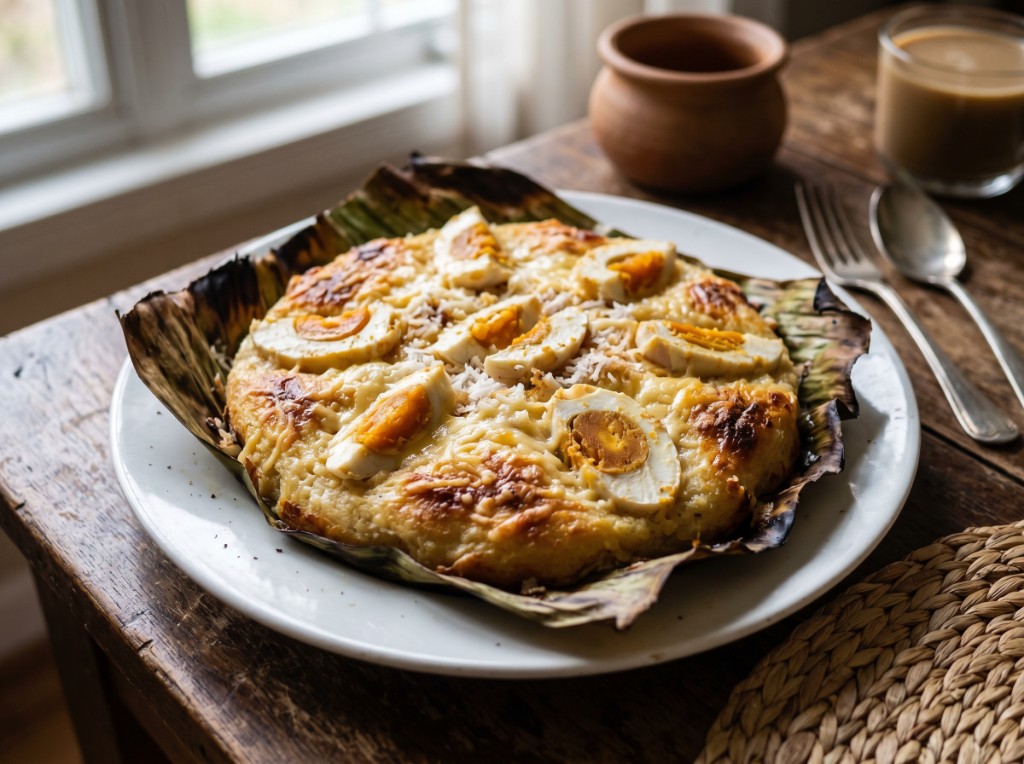
Christmas bibingka on charred banana leaf—moist rice cake topped with salted egg, melted cheese, and fresh grated...
Serves 8 · 1h 5m total
The Story
Sold outside churches during Simbang Gabi, bibingka is inseparable from Filipino Christmas. The rice cake baked in clay pots with coals above and below predates electric ovens—it is Advent tradition made edible.
Spanish-era church masses created the market: worshippers cold at dawn wanted something hot, sweet, and portable. Vendors set up on the plaza with banana-leaf liners, salted egg, cheese, and fresh coconut as toppings that signified abundance at Christmas.
Bibingka spread from roadside clay ovens to home kitchens and mall counters, but the Simbang Gabi memory remains. Charred leaf edges, soft center, salty-sweet toppings—bibingka is how many Filipinos mark the season whether or not they still attend dawn mass.
Best paired with
Salabat (ginger tea) or hot tsokolate after Simbang Gabi mass
Lola's Tips
- ✦for the browned cheese and salted-egg spots—stand at the oven; 30 seconds too long burns the top.
- ✦so yolks stay visible and creamy, like the photo.
- ✦and cover loosely with foil for 5 minutes.
- ✦—reheat wrapped in the leaf at 300°F for 8 minutes.
Substitutions
- glutinous rice flour → all rice flour (less chewy) or 2 tbsp cornstarch per ½ cup omitted
- quick-melt cheese → Eden or cheddar; grate your own so it melts evenly
- salted duck egg → extra cheese only, or chicken salted egg if duck is unavailable
Ingredients
placeholder
placeholder
placeholder
placeholder
placeholder
placeholder
Instructions
- 1
Prep banana leaves: briefly pass each piece over a gas flame until glossy and pliable (not ash)—this gives the smoky bibingka aroma. Line 8-inch round pans or tart molds, letting edges hang over the sides.
- 2
Whisk rice flour, glutinous rice flour, sugar, baking powder, and salt in a bowl. In another bowl, beat eggs with coconut milk (and coconut cream + vanilla if using) until smooth.
- 3
Pour wet into dry and fold until just combined—small lumps are fine. Do not overmix or the cake turns tough and dry.
- 4
Pour batter into lined pans until about two-thirds full. Tap pans to release bubbles. Bake at 350°F (175°C) on the middle rack 15–18 minutes until edges pull away and the center is set but still moist.
- 5
Remove from oven. Arrange thick slices of salted egg and a generous layer of grated cheese on top of each cake.
- 6
Return to oven on the upper rack, or switch to broil on high 2–4 minutes, until cheese bubbles and the top browns in spots like street bibingka—watch constantly so it does not burn.
- 7
While hot, brush tops and leaf edges with melted butter or coconut oil. Sprinkle fresh grated coconut in the center of each cake.
- 8
Serve warm still on the charred banana leaf—with salabat (ginger tea) or hot tsokolate after Simbang Gabi.
Kitchen Timer · 30 min prep first
35:00
Tried this recipe?
Questions, corrections, or a photo of your Bibingka? We read every message—no comment section, just a direct line to the kitchen.